
Why Are There Four Fashion Capitals In The World?
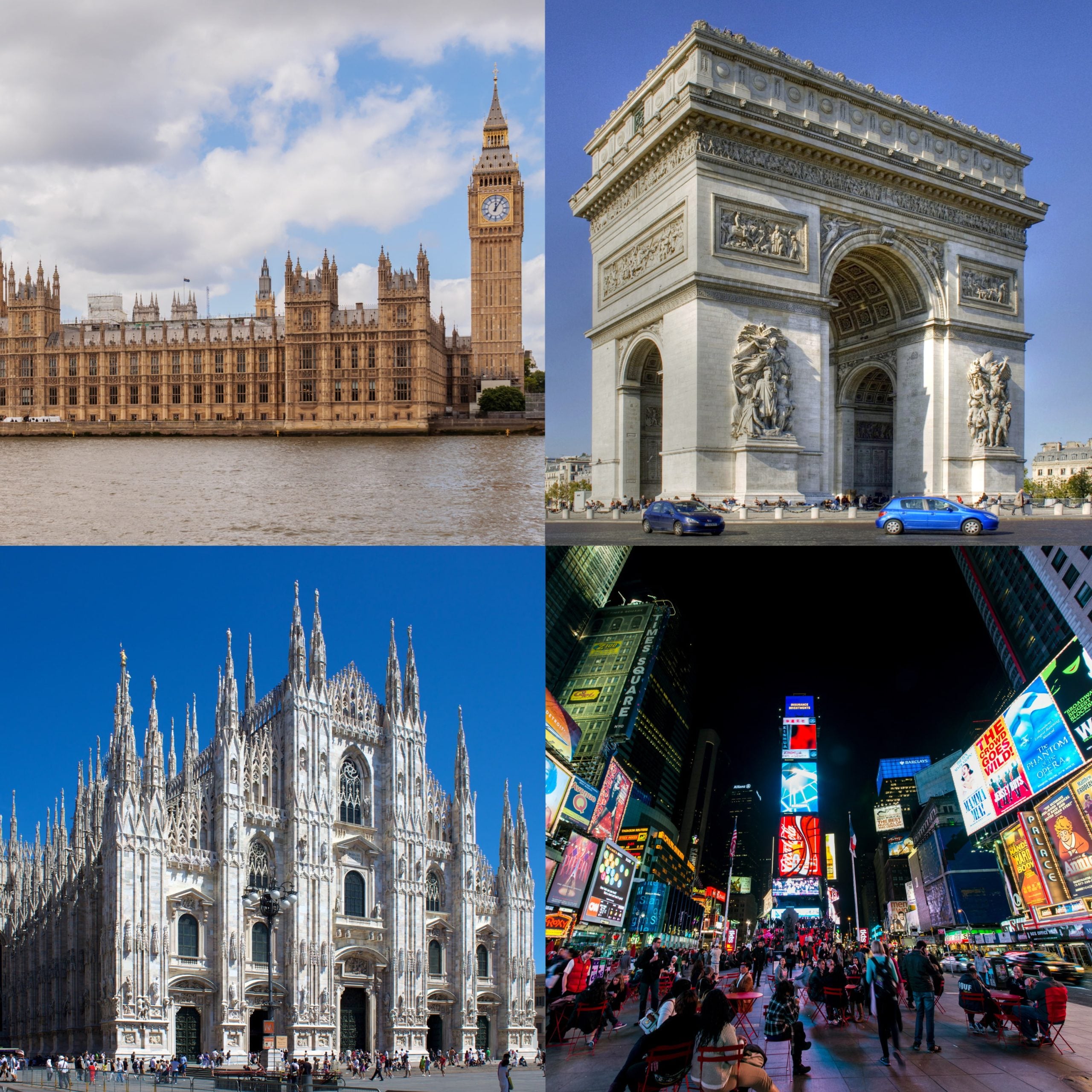
You may have once asked yourself the question, why are there four fashion weeks around the world. These four are London, Paris, Milan, and New York. But why these? Why are there four fashion weeks? Well, it’s simple in one way, they are just the epicentre of creativity. They produce the most good stuff. But how did we get to this point? Why did all the other centres of fashion fall into obscurity.
The (Traditional) Big Three Fashion Week Capitals
Why are there four fashion weeks? Well, traditionally, there are only three. This makes sense of course. The European continent has been active at all sorts for a long time. Modern and industrial technology was a much more recent addition to the Americas. And it came with the settling of the land by Europeans. Of course, traditional people’s in America also have a diverse array of different clothing types and ways of expressing themselves. But you really need industry to get yourself going in a big way with fashion. In the following examples, you’ll see why each of these places used industry and cultural inventiveness to achieve their position.
London, The Home Of Modern Formal Wear
Britain invented the modern suit, coming out of the military dress coat. The admirals and generals always wore smart formal jackets, and people loved them. Those gentlemen that weren’t in the military wanted to look that way, but couldn’t wear a ranked uniform. They asked tailors on Saville Row to produce something similar, with a flattering cut. That is why you have the classic lapel. It is the part of the all-weather jacket that you unfold and button up in the rain. Then it was tamed for the civilian market, and the modern and so the suit jacket was born.
Coming out of Saville Row, this meant massive adoption among London’s upper crust. Everyone went to Saville Row if they worked in London and had wealth. So when a few started adopting this tradition, soon the entire city did. This being the 19th Century, the British Empire was on top of the world. Many of these men were diplomats and important businessmen. They soon travelled far and wide in the newest sartorial trend, and people saw and admired their new look. And the rest is history. If anywhere deserves to have a fashion week, it’s London.
Paris, A History Of Trailblazing
As for the French, it is a little more complex. The centre of European culture throughout the late Middle Ages until the Napoleonic period was Paris. That is a bold claim, and very complex, but there is a lot of truth to it. It was a huge centre of learning and culture. Every noble in Tsarist Russia was fluent in French. It was the accepted language for diplomacy too, replacing Latin as the common tongue of the Europeans. It became the lingua franca of Europe and possibly the world. The term itself means the “language of the Franks”. Thanks to this, if the French pioneered something, the world followed.
One tradition was portraiture. Many French nobles and royalty had portraits made. And they would display their wealth by being extremely lavish in their set design. The frills and jackets and frocked coats and, indeed, stockings were all on display too. One particular person known for this is Marie Antoinette. She was so adored and emulated among high society, that anything she wore became the fashion. This set the tone all over Europe for what the season should look like. See the BBC’s article on this for a fascinating history.
Milan, A Legion Of Passionate Designers
Milan is an interesting one. Italy itself has many reasons to be the number one name in fashion. Being a landmass that sticks out into the sea meant that it has many landing areas for ships. This meant it has always been a fantastic hub of trade and exchange. Venice is the obvious example of this. It was possibly history’s most valuable port. The gateway to all of Europe, as you could easily move through the Alps and up numerous rivers from there. Places of trade always attract variety and talent. So it’s no wonder that Venice was also a big textile producer. But today, let’s talk about Milan. That is where the Italian fashion week is, after all.
Milan is possibly the largest industrial area in Italy, with the exception of Turin. But whilst Turin made great cars and chocolate, Milan made clothing. This is due to their mills which produced bolts of cloth faster and cheaper than anywhere else in the nation. Milan, and really all of Italy, has another advantage. The boutique brand. Ironic it should be a French word, but the Italians do it better than others. There are many smaller producers of clothing in Italy, with big names like Armani or Visace being an exception. Really, most brands make things in smaller batches and concentrate on a narrower range of items. They have a design culture that means lots of small success stories, and lots of creativity.
New York, New Fashion Week, New Frontier
This is the fourth of the four capitals, and the newest. New York’s history is a fascinating one. It is a relatively young city, but nevertheless it is one of the best for fashion in the world. Why is this exactly? Well, for one, it was one of the earliest cities in the Americas. Originally it was a Dutch colony, and they were the masters of trading. That alone meant they were connected to all the great textile producing capitals of the world. You could get cotton and wool and linen from any continent on the globe. This continued after the English took over the colony, and well past 1776 when the USA got its independence.
It is also interesting how New York is laid out. The grid system meant that you would be able to cordon off city blocks easily. This lead to the phenomenon known as the Garment District. A portion of Manhattan would be blocked off and the streets would be occupied by tailors and clothing salesmen. This made it easy to go and get clothes off the rail, still a burgeoning industry at the time. This gave access to affordable fashion for everyone. This meant styles could be turned over quicker, so you have something new each season.
Conclusion
To get a fashion capital that produces beautiful clothing year after year is a rarity. It really is like catching lightning in a bottle. But it seems fashion lovers worldwide have caught lightning in a bottle more than once. At least four times throughout history, in fact. Each of these locations are still powerhouses of production and creativity. We adore them all for the work they do. And every fashion week is a time of great excitement for the UK Tights team.




One Comment
Pingback: